

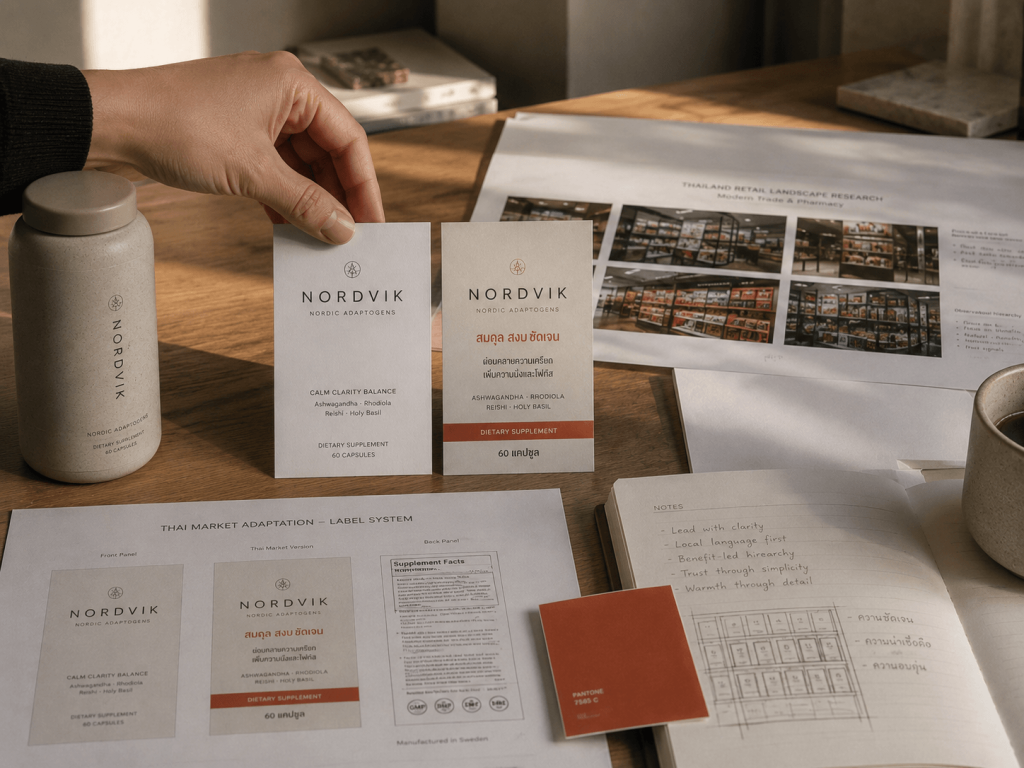
NORDVIK branding design inspiration workspace
Localising a Nordic brand for Thailand is not about adding colour. It is about finding the Thai equivalent of restraint.
This distinction matters because the most common localisation mistake is treating the Thai market as a place where Nordic brand values do not apply, where you need more noise, more persuasion, more visual density to compete. That assumption produces brands that feel neither Nordic nor Thai. They satisfy neither audience.
The better frame is translation, not substitution. The values that built the Nordic brand, product integrity, sourcing transparency, evidence-backed claims, are not obstacles to Thailand market entry. They are assets. The task is finding how those values are expressed in a Thai retail and cultural context, not replacing them with something louder.
What Nordic brand equity is actually made of
Nordic brand strength in health, wellness, and lifestyle categories rests on three foundations: credibility (the product does what it claims, and the claim is substantiated), restraint (the brand does not oversell, which signals confidence), and provenance (the origin story is clean, specific, and verifiable).
These are not aesthetic choices. They are trust signals calibrated for a consumer base that is highly literate, institutionally trusting, and sceptical of persuasion. In Scandinavian markets, a brand that does not need to argue loudly for itself is a brand that knows it is right.
Where it breaks down in Thailand
Thai retail communication operates on different trust signals. In Bangkok’s pharmacy chains, wellness concept stores, and modern trade health sections, consumers navigate a dense information environment. Benefit claims are prominent. Product category signals are visual and immediate. The colour architecture of health and wellness packaging carries established cultural meaning, certain tones signal efficacy, others signal natural origin, others signal premium positioning.
A Nordic brand that arrives with minimal packaging, small typography, and no prominent benefit claim in Thai does not read as premium. It reads as absent from the conversation. The restraint that signals confidence in Helsinki reads as silence in Thonglor.
There is also a regulatory layer. TFDA Notification No. 388/2023 requires bilingual labelling, all ingredient lists and required disclosures must appear in Thai and English. But compliance is only the floor. A bilingual label that simply translates the European copy without adapting the claim architecture will often fail to communicate to the Thai consumer even when it meets the legal standard.
The difference between translation and dilution
Translation preserves the brand’s values while changing their expression. Dilution changes the values to fit market expectations.
A Nordic wellness brand that adds a prominent Thai-language benefit claim, properly substantiated and TFDA-compliant, is translating. A Nordic wellness brand that adds unsubstantiated claims because it assumes Thai consumers expect them is diluting. The first builds a brand with long-term equity in Thailand. The second creates a short-term sales argument with compliance risk and brand integrity cost.
The distinction requires knowing both markets well enough to understand which adaptations are translations and which are compromises. Most brands working without dual-market expertise cannot reliably make that call.
What successful localisation looks like in practice
Nordic brands that navigate Thailand well share a common approach. They identify two or three core trust signals, the things that made the brand work at home, and find their Thai equivalents.
Proof translates to clinical or pharmacist endorsement, structured as a visible credibility element on the packaging or in the retail environment. Provenance translates to a sourcing narrative told in Thai, specific and verifiable, embedded in the label and the retailer relationship. Restraint translates to a visual architecture that is quieter than its competitors but still communicates within the established visual language of Thai wellness retail, using whitespace strategically rather than abandoning structure entirely.
They also invest in the credibility chain before the product arrives on shelf: a pharmacy buyer relationship, a health content partnership, or a clinical professional association. This is not marketing spend in the conventional sense. It is the infrastructure that makes the brand legible to the Thai consumer before purchase.
The brands that get it wrong, and right
The brands that get it wrong arrive with their European packaging translated but not adapted, and a distribution agreement with no credibility infrastructure behind it. The product sits on the shelf, beautiful and invisible.
The brands that get it right invest 6 to 12 months in market preparation before the product arrives, researching the retail environment, adapting the label architecture, building the credibility chain, and establishing the distributor relationship on terms that include channel support, not just logistics.
The result is a product that a Thai consumer can find, read, and trust, in a language that is recognisably Nordic in its values and recognisably Thai in its communication.