

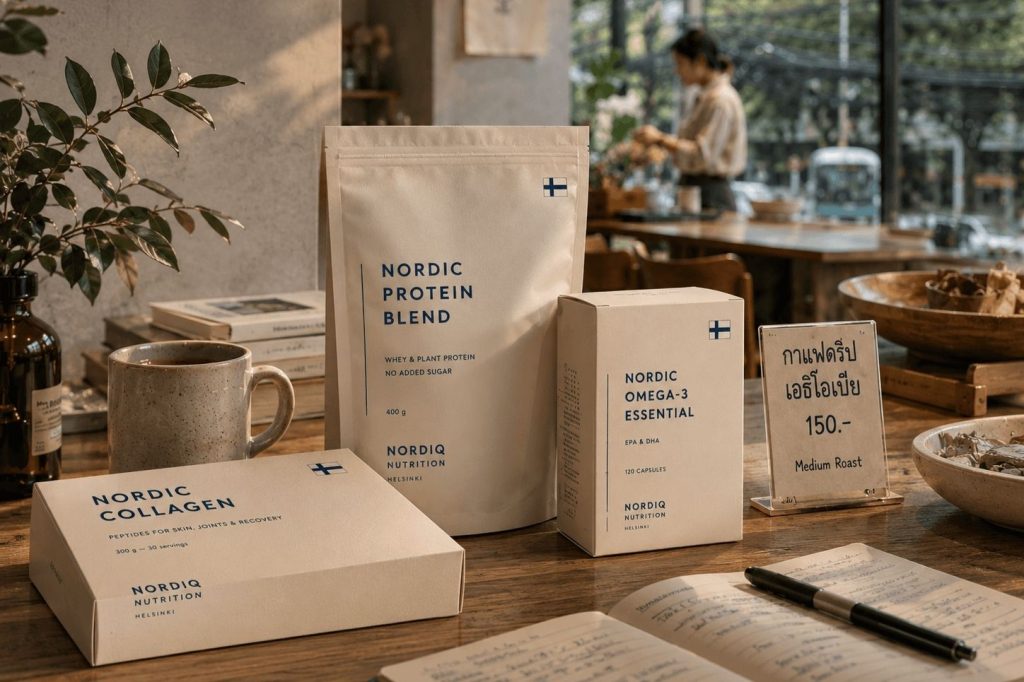
Cozy café vibes with Nordic products
What Thai wellness buyers actually see when a Nordic brand arrives
Thailand’s wellness market is growing at 28% a year, four times the global average (Global Wellness Institute, 2025). The country ranks first globally in wellness tourism, with 36.4% year-on-year growth in that category, and is hosting the Global Wellness Summit in Phuket in 2026. The Thai government has set a top-five global wellness ranking as a formal 2030 target. This is not an emerging market discovering wellness. It is a market at the front of a global shift, with sophisticated buyers at every level of the value chain.
For Nordic brands entering this environment, country of origin carries more commercial weight than most market entry briefs acknowledge. Finnish, Swedish, Norwegian, and Danish provenance signals something specific to Thai wellness buyers: rigour, restraint, and a quality standard enforced by systems they already trust. The Swedish government’s strategic healthcare partnership with Thailand, signed in 2025, did not create this trust. It confirmed what had been building at the consumer and trade level for years.
At the consumer level, the Thai wellness buyer choosing a Nordic supplement, functional food, or skincare product is not buying Nordic minimalism as a visual identity. They are buying it as a quality promise: the clean label, the short ingredient list, the sense that nothing unnecessary passed through the production process. This distinction between aesthetic and promise is the one that Nordic brand teams most consistently miss when preparing a Thai market entry strategy.
At the B2B level, distributors, premium retail buyers, and hospital procurement managers need something different from a Nordic brand. What Thai trade buyers respond to is not aesthetic credibility but clinical credibility: evidence that the standard behind the product can be defended to their own end customers. The combination of Nordic origin and verifiable quality data is a strong commercial argument. It does not need to be constructed from scratch. It needs to be communicated in a language and register that Thai buyers can actually use.
Why Nordic brands fail in Thailand’s wellness market
The failure is rarely the product. In FINTH’s experience working across this corridor, the breakdown almost always occurs at the point where the brand story meets the Thai market. There are two failure modes, and they pull in opposite directions.
The first is over-localisation. This is the Nordic brand that enters Thailand, senses that the market feels different, and begins softening its provenance signals to appear more accessible. It translates the visual identity into warmer, more overtly tropical palettes. It adjusts the tone until the Nordic quality register disappears. It tries to feel Thai. In doing so, it removes the one thing Thai buyers were actually purchasing: the assurance that comes from not being Thai. The provenance advantage is not a liability to be managed around. It is the asset.
The second failure mode is the opposite: under-translation. This is the Nordic brand that treats Thailand as a new geography for an unchanged product, and assumes that quality will speak for itself. It keeps all communications in English or Finnish. It sends the same retail pack that sells in Helsinki or Stockholm. It attends a Bangkok trade fair once and waits for distributor interest to arrive. Quality does not speak for itself in a market where it cannot be read. A product with no Thai-legible narrative, no channel strategy built for this market, and no local partner who can place it correctly will remain genuinely good and completely invisible.
Both failure modes share the same root: a misunderstanding of what localisation actually means in this context. The goal is not to become Thai. The goal is to make clear, in Thai, exactly what being Nordic already means.
What effective Nordic brand entry in Thailand requires
Successful Nordic brand entry in Thailand begins before the distributor conversation. The brands that build durable positions in this market have three things in place before they sign anything.
First, a brand narrative that has been translated not just linguistically but culturally: one that renders the quality signals Thai buyers respond to in a register that lands for them, not for a Helsinki focus group. This is cultural strategy, and it is distinct from translation work.
Second, a partner selection process that goes beyond enthusiasm at a trade fair to assess whether a potential distributor has the category knowledge, the channel relationships, and the operational capacity to actually sell the brand, not just stock it. A Thai partner who cannot tell your brand story in Thai, to the right buyer, in the right channel, will not sell it. The signed contract is not the result. It is the starting point.
Third, internal ownership: someone inside the Nordic organisation who is responsible for Thailand, who maintains the partner relationship, and who is reachable between quarterly visits. Thai business relationships are built on consistent, low-friction presence. The companies that manage this market like a remote European account lose it quietly and are usually unsure why.
The first 90 days in a new market are less about sales and more about positioning. A Nordic brand that arrives in Bangkok with a clear quality narrative, the right local partner, and a realistic channel plan will spend those 90 days learning the market. A Nordic brand that arrives without those three things will spend them discovering they were necessary. FINTH’s market entry services are designed precisely for this stage: helping Nordic health and wellness brands build the strategy, the brand story, and the partner relationships before the launch, not after the first distributor contract has expired without results.
FINTH’s view: where this window closes
Nordic provenance will not remain an underused asset in Thailand’s wellness market indefinitely. The market is growing, the sector is professionalising, and more international brands from Japan, South Korea, Australia, and across Europe are competing for the same shelf space and the same distributor relationships. As that competition intensifies, origin signals will become noisier. The brands that establish what Nordic quality means in this market now, not as a vague claim but as a specific, evidenced, Thai-legible proposition, will own their category positioning when the market consolidates. That window is open in 2026. In three years, the cost of building that position will be considerably higher, and the category conversation will already have voices in it. The flag is already speaking. The question is whether your brand knows what it is saying.